
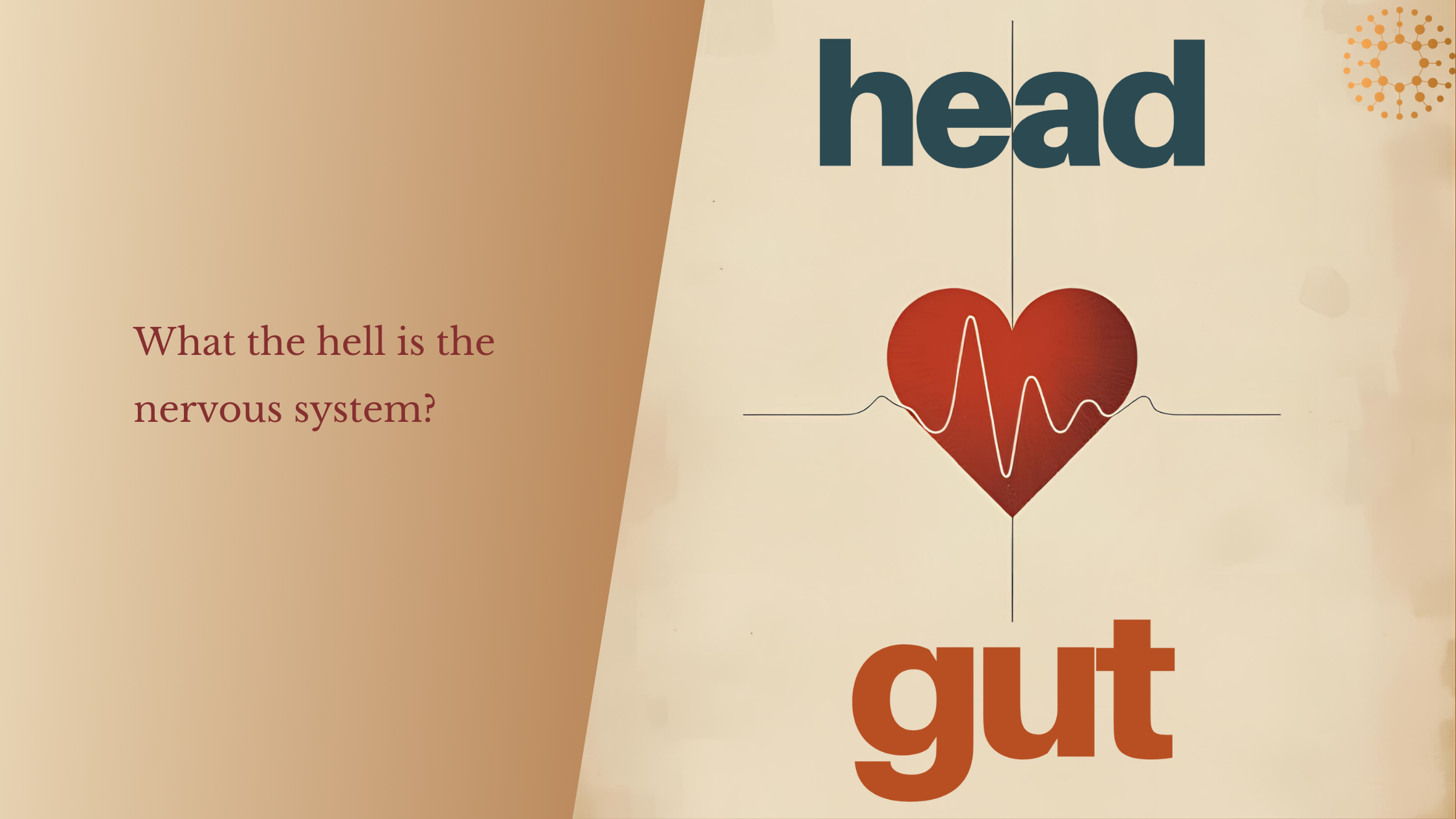
What the hell is the Nervous System?
I know, everyone's talking about the nervous system. It's in every post and every podcast.
The fact that the term is being overused is GOOD!
It means regular people (not therapists and neuroscientists, but people like you and me) are finally paying attention to this part of us we've been ignoring. Because we haven’t been educated about it.
Quick disclaimer: I'm not a neuroscientist and neither claim to be an expert on this. I'm just someone who reads books, makes notes, forms ideas. The books are out there (not reels, actual books) for all of us to access. For this article, I read "The Polyvagal Theory" by Stephen Porges.
The Body and Soul
That expression "body and soul" is not poetic. It's your nervous system. And it's been trying to get your attention. When people say "listen to your body and soul," they're talking about your nervous system. Specifically, the vagus nerve.
Your nervous system is the entire network of nerves throughout your body: your brain, spinal cord and all the nerves that branch out from there. The vagus nerve is the longest nerve in this network. It runs from your brainstem down through your neck, chest and into your abdomen, connecting your brain to your heart, lungs and digestive system all the way to your gut.
When does your brain send signals through this nerve? When it gets input, either from your external context (what you're experiencing right now) or from your memory (past experiences and learned patterns). But here's what most people don't know: the communication goes both ways. Your heart and gut send more signals back up to your brain than your brain sends down.
Your heart has about 40,000 neurons. Scientists call it "the heart brain." This is why you literally feel emotions in your chest. Heartbreak isn't poetry. It's your heart's neural network telling your brain something's wrong.
Your gut has around 100 million neurons, the enteric nervous system. This is why you "feel it in your gut" when something's off. Why anxiety messes with your stomach. Why you lose your appetite when you're stressed.
Paul Olteanu, who runs the Mind Architect podcast in Romania and translates neuroscience for people like us, calls this understanding "the foundation of how we actually function." Mechanical, not mystical.
Brain, heart, gut. This is the three-part system. When these three are talking clearly, you make decisions that feel right. When they're not? You're stressed-out. I will call this dysregulation from now on.
What Dysregulation Looks Like
Dysregulation isn't a diagnosis. It's what happens when your nervous system runs on high alert for so long that your body's signals get scrambled.
I saw this constantly in sales. Pain got normalized as toughness. Questioning it was weakness. And then you think, well, it's not supposed to be easy. You're supposed to put in the effort. Yes, you are. But are you doing it while being... fine? While your nervous system is actually calm?
In real life, dysregulation looks like this:
You're stuck in your head, overthinking everything. You can't make a decision without polling five people, reading ten articles and still feeling unsure or too scared to make a decision.
You feel numb to physical pain. You ignore headaches, push through exhaustion, don't notice tension until someone points out your shoulders are up to your ears.
You feel numb to emotions. High-intensity emotions don't land. You watch a sad movie and feel nothing. Someone tells you good news and you can barely muster excitement.
You overreact to small things. Someone forgets to text you back and you spiral into "they hate me." A minor work critique feels like a personal attack.
You pick fights for no clear reason. You're irritable, snappy, looking for conflict even when things are fine.
You want to disappear. Not in a dramatic way, just a wish in your head that you could cease to exist for a while because existing feels like too much.
You disregard your emotions or rationalize them away. "I'm not actually upset, I'm just tired." "It's not a big deal, other people have it worse." You explain away your feelings instead of feeling them.
If you're reading this list thinking "well, that's just normal life," that's the problem.
We've normalized dysregulation so thoroughly that we think it's just how humans operate.
It's not.
This is very important
Here's what happens when you're dysregulated:
Your vagus nerve has two main branches. The newer one (ventral vagal) is your "social engagement system." When this is active, you feel safe, connected, present. You think clearly, connect with others, trust yourself, just feel calm.
The older one (dorsal vagal) is your shutdown system. When your nervous system decides a threat is too big to fight or flee from, it shuts you down. You go numb and dissociate.
Dr. Stephen Porges (a neuroscientist) explains this in Polyvagal Theory: your nervous system is constantly scanning for safety or threat. When it detects safety, you stay engaged. When it detects threat, you go into fight-or-flight. When the threat feels overwhelming, you shut down.
There’s an issue because most of us have been in threat mode for so long that our threat detector is broken. A full inbox triggers the same response as being chased by a bear. Your body can't tell the difference between "difficult conversation today" and "about to die."
This is why your reality reflects your internal state. Dysregulated nervous system? Everything feels threatening. Regulated? Same circumstances, manageable.
You can't think your way out of this. Your brain isn't in charge. Your body is.
How Awareness Training Regulates Your Nervous System
You can't regulate what you can't feel. That's the problem most people face: years of ignoring your body's signals means you've lost the ability to notice when your nervous system is activated.
My method works in three layers and each one directly addresses nervous system regulation:
First, you learn to recognize what activation feels like. Not intellectually, physically. Where tension lives in your body. What calm actually feels like (most people have forgotten).
Think of this like giving yourself a massage. You're checking in with your entire system, noticing where you're holding stress, where things feel tight or numb or just weird.
This is building your interoception, your ability to sense what's happening inside you. Without this, you're flying blind.
Then, you start seeing your patterns. You notice when you're performing instead of being present. When decisions come from "should" instead of what you actually feel. When you're seeking external validation because your internal signals got scrambled. This awareness doesn't fix anything immediately, but you can't change what you can't see.
Finally, you learn to trust your body's signals again. You check decisions against your gut without being afraid or thinking “Only logic has a place here, not what I feel.” You distinguish between relief and contraction. You start making choices based on what your body knows, not what your anxious brain is catastrophizing about.
This is training. You're retraining your nervous system to recognize safety, respond appropriately and trust the signals you've been taught to ignore.
Three Exercises to Start Regulating
Exercise 1: Are You Dysregulated Right Now?
Go through this checklist honestly. It’s just you here.
In the past week, have you:
Spent hours overthinking a decision
Ignored physical discomfort or pain
Felt emotionally numb or flat
Overreacted to something small
Picked a fight or been unusually irritable
Wished you could just disappear for a while
Talked yourself out of your feelings
If you checked more than two, your nervous system is trying to tell you something.
Exercise 2: Counting to 100
A few years ago, my husband was sick and I was so overwhelmed I wanted my mommy. I felt like I wanted to disappear, that familiar feeling of "I can't do this anymore." So I started counting to 100.
I felt crazy at first. But now I do it when I can't fall asleep, when I'm anxious about something happening right now, when my brain won't shut up. And it always works.
Counting forces your brain into the present moment. It gives your prefrontal cortex (the thinking part) a simple task, which quiets the amygdala (the panic button). You can't catastrophize about the future while you're counting. Your nervous system gets a break from scanning for threats because your brain is busy with a concrete task.
Try it next time you're spiraling. Just count. Out loud if you can, silently if you need to. Just do it.
Exercise 3: The 5-Minute Body Reset
This combines what neuroscience knows about interoception (your ability to sense what's happening inside your body) and bilateral stimulation (engaging both brain hemispheres to calm your system).
Here's how:
Pause. Stop what you're doing. Close your eyes if you can.
Scan. Notice where you're holding tension, numbness or any sensation. Don't try to fix it. Just find it. Is it your jaw? Your chest? Your stomach? It’s like giving yourself a massage and finding the tension.
Stay. Keep your attention on that spot for 30 seconds. Don't explain it away. Don't rationalize it. Just notice: "There's tightness in my chest." That's it.
Tap. Gently alternate tapping your knees (left, right, left, right) while keeping your attention on that sensation. Do this for 2-3 minutes.
Check. Did anything shift? Did the sensation change, move, soften? Did an emotion come up? Don't judge what happens, just look at it.
This Isn't Mystical, It's Mechanical
The nervous system conversation isn't going away. And that's good.
For too long, we treated our bodies like machines that should just work. We optimized our thinking while completely disconnecting from what our bodies were screaming at us. Or we got a fitness trainer and said to ourselves “I’m doing the body work.” You’re not, you’re just covering it with something else.
A few years ago, when Paul Olteanu's Mind Architect podcast really took off in Romania, some neuroscience professors from a reputable university trashed him publicly. They were like “he shouldn’t be speaking about this stuff, cuz he’s not a scientist.” And this shows a real problem with academia. The knowledge gets locked behind university walls, accessible only to those who study it formally. But shouldn't something this essential to our quality of life be public knowledge?
That's why I love what Paul is doing. And why I love what I do: reading books, making notes, forming ideas. The knowledge is out there. Available to all of us. We just have to grab it.
Try one of these exercises this week. Not to track progress or fix yourself. Just notice what happens and write in the comments, if you’re up to share.
